Welcome to the AgarOud Global resource hub. Here you will find the laboratory evidence behind our oils, a plain-language guide to our oil types, how agarwood oil is made, how to choose, use and store it, and a short glossary. If you cannot find what you need, our team is one message away.
Jump to: Quality & testing · Our oils · How it is made · Choosing, using & storing · Glossary · Samples & wholesale · Help
Quality & testing
We stand behind our oils with traditional production, GI certification, independent laboratory analysis and a 100% payback policy.
GI certified
Our oils carry GI (Geographical Indication) certification, recognising their Sylheti origin in Bangladesh.
Independent lab analysis
An agar oil sample submitted by AgarOud Global was analysed by BCSIR using GC-MS. The full report is shown below.
100% payback
Full refund if a product differs from its description, contains any synthetic ingredient, or you simply do not like it. Read the policy.
BCSIR analysis report
The report was issued by the Bangladesh Council of Scientific & Industrial Research (BCSIR), Institute of Food Science & Technology (IFST), Dhaka. Click the image to view it in full size.
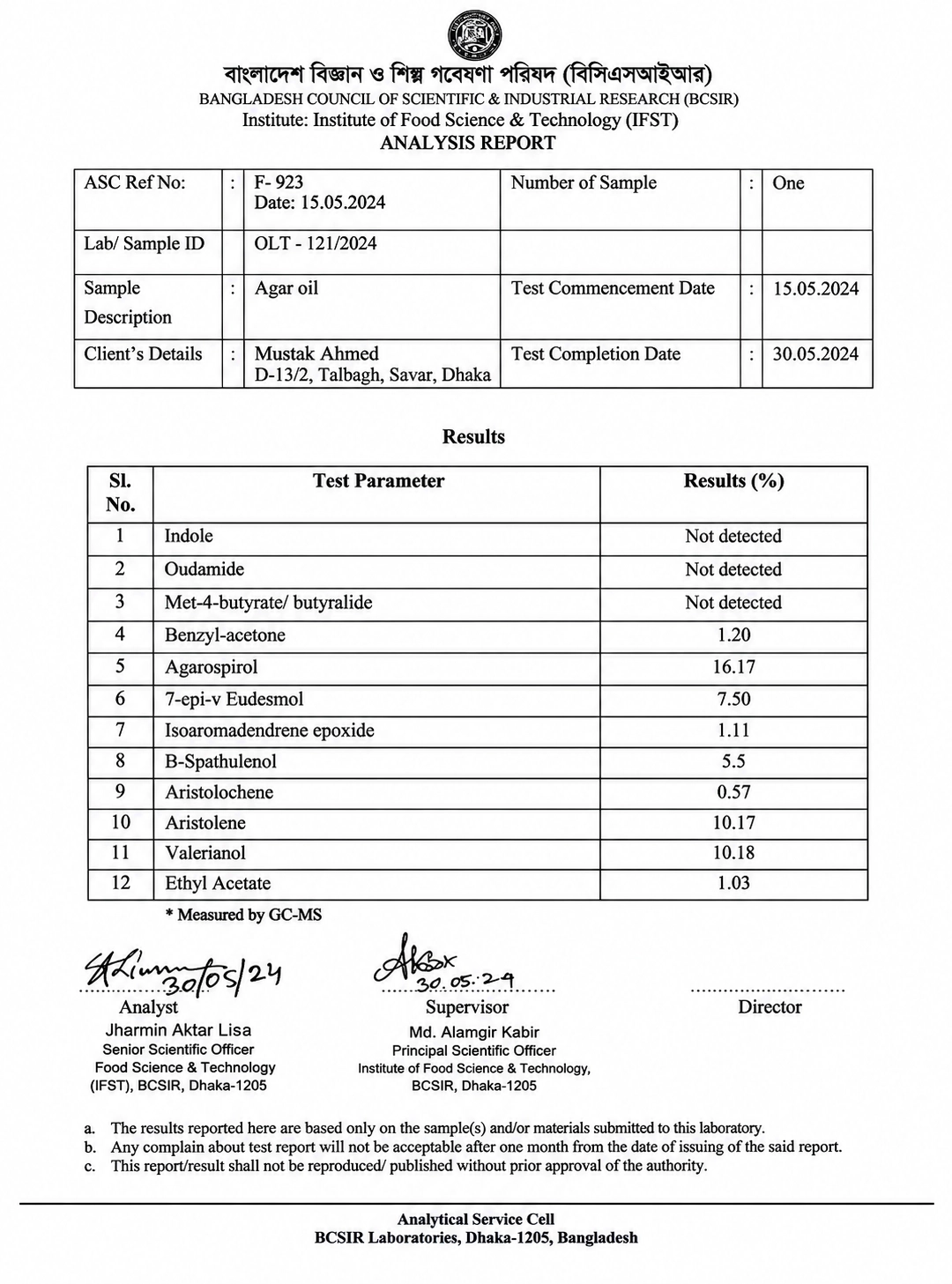
- Reference number: F-923, dated 15.05.2024
- Lab / sample ID: OLT-121/2024
- Sample description: Agar oil (one sample)
- Test period: 15.05.2024 to 30.05.2024
- Method: GC-MS (gas chromatography-mass spectrometry)
View the full list of measured compounds
| No. | Test parameter | Result (%) |
|---|---|---|
| 1 | Indole | Not detected |
| 2 | Oudamide | Not detected |
| 3 | Met-4-butyrate / butyralide | Not detected |
| 4 | Benzyl-acetone | 1.20 |
| 5 | Agarospirol | 16.17 |
| 6 | 7-epi-v Eudesmol | 7.50 |
| 7 | Isoaromadendrene epoxide | 1.11 |
| 8 | B-Spathulenol | 5.5 |
| 9 | Aristolochene | 0.57 |
| 10 | Aristolene | 10.17 |
| 11 | Valerianol | 10.18 |
| 12 | Ethyl Acetate | 1.03 |
As stated in the report, the results are based only on the sample submitted to the laboratory.
Our oils
AgarOud oils come from agarwood trees in Sylhet, Bangladesh and are grouped into three ranges. Each product page lists the details of that oil.
Signature Oils
Our own signature selection, including oils distilled with natural rose water or mineral-balanced alkaline water.
Pure Wild Oils
Oils from naturally grown wild agarwood trees, with tree ages such as 50, 70 and 80 years.
Plantation Oils
Oils from plantation-grown agarwood trees, such as our 30-year-aged plantation oil.
How agarwood oil is made
Agarwood is the dark, resin-rich heartwood that forms inside Aquilaria trees. Its oil, often called oud oil, is one of the most valued natural perfume materials. In general, hydro-distillation works like this:
- Collecting: resin-rich agarwood is gathered from wild or plantation-grown trees.
- Preparing: the wood is chipped or ground and soaked in water.
- Distilling: the soaked wood is heated so that steam carries its aromatic compounds upward.
- Condensing: the vapour is cooled back into liquid, and the oil separates from the water.
- Resting and bottling: the oil is collected and bottled.
AgarOud oils are traditionally hydro-distilled. Our Signature oils are distilled with natural rose water or mineral-balanced alkaline water.
Choosing, using & storing
This is general guidance for fragrance use, not medical advice.
Choosing
- Ask where the oil comes from and whether the trees are wild or plantation-grown.
- Ask for the tree age and the distillation method.
- Ask for independent lab analysis, such as GC-MS.
- Be careful with prices that look too good to be true.
- Judge the scent over several hours, not the first few seconds.
Using
- Oud oil is highly concentrated, so start with one small drop.
- Apply to pulse points such as wrists and neck, or blend with a carrier oil.
- Test a small area of skin first.
- Keep away from eyes, and note that oils may stain fabric.
Storing
- Keep the bottle tightly closed.
- Store in a cool, dark place.
- Keep away from direct sunlight and heat.
- Keep out of reach of children.
Glossary
- Agarwood: resin-rich heartwood formed in Aquilaria trees, used to make oud oil and incense.
- Oud (oud oil): the Arabic name for agarwood and the oil distilled from it.
- Hydro-distillation: extracting oil by heating plant material in water so the vapour can be condensed and collected.
- Wild vs plantation: wild trees grow naturally, while plantation trees are grown and managed by growers.
- GI (Geographical Indication): recognition that a product comes from a particular place and carries qualities linked to it.
- GC-MS: gas chromatography-mass spectrometry, a laboratory method that separates and identifies the compounds in a sample.
- Agarospirol: one of the aromatic compounds found in agarwood oil and listed in the BCSIR report.
Samples & wholesale
Try before you buy
The AgarOud Samples Pack includes 10 varieties of agarwood oud oil (2.5 g+ in total) for $109.
Wholesale & perfume brands
We supply oud oil to perfume makers and wholesale buyers. For quantities and pricing, message us on WhatsApp or email info@agaroudglobal.com.